Wednesday, April 15, 2015

A Comment on the Hawaii Run


Let us sail away from the cold winds and driving storms of the Aleutian Islands for a moment into the tropical climes.  One unique contract our company has is to run freight barges to Hawaii.  The Hawaii Run, it is known as.  Some love this run, most hate or even fear it, and some enjoy it as a break from the grind of working in Alaska.  It could be important to mention here because this run contrasts well with the run of the Malolo, otherwise known as the shuttle run, in which we are shuttling barges all about.  Where as the longest average stint at sea between ports on the Malolo is usually 2 days, the trip to Hawaii averages 11 days with good weather.  And this run can assist us in looking into what a daily routine looks like on ships when the crew gets underway. 

There are two tugs designated for Hawaii.  The Phyllis Dunlap, and the Polar King.  Our journey will be with the Phyllis, which is the company’s newest boat, and also the one that seems to be regarded with the greatest animosity by the crews.  She is spacious in her accommodations, which feels homey and nice until a heavy sea pitches the ship about.  Then the inhabitants are flung about the spacious walkways and galley with nothing to break their momentum, and she is notorious for flinging about.  One sailor said, ‘The bitch will make you dance with her, and she will take the lead every time.’  For reasons of weight distribution and other design flaws she never develops a steady rhythm in her rocking, but instead will seem as though there is a steadiness, then suddenly lurch you, most often while you are in a doorway or descending a ladderwell.  On certain trips the crew have come off with bruises, and some with broken bones from her surly ways. 


The contract for Hawaii has a barge leaving Elliot Bay, Seattle every other Friday.  However, the company office and docks are in Everett, Wa.  So the cook arrives first, around eight in the morning, and takes the truck to the store to pick up provisions for the trip, and by the time he returns the crew is there and ready to help him load his stores. The ship gets underway around noon, the company dock workers wishing those on board a happy voyage and safe weather as they cast off lines. 

She travels the hour and a half into Seattle where she takes on fuel and water.  50,000 gallons of fuel to suffice the 11 days underway, then after dark, usually just before midnight, she goes out into the bay and takes the barge from the harbor tugs.  The crew makes up the tow wire, checks the barge for loose items, secures the docking lines on it, then climbs back aboard, casts off, streams out the tow wire, and away they go. 

12 hours later, around lunch the next day, they pass the Straits of Juan de Fucca and enter the Pacific Ocean.  Here the ship begins the steady roll beneath their feet as they set a course, make their last phone calls, get settled in, and finally can feel that they are underway. 

Now begins the routine that maintains the sailor’s sanity.  Without routine his mind becomes bored, in boredom he looks at the calendar, and the clock, he counts the days, hours, minutes, tasks, barriers, he thinks of home and all the problems he cannot control at sea; he goes mad.  So everyone carefully organizes his time to keep occupied.

The watches are divided into three watch teams of two.  The midnight to four watch is stood by the second mate and the AB, the four to eight by the chief mate and the cook, the eight to noon by the captain and engineer, then it rotates through in the same way for the afternoon.   The duties of the captain and mates are primarily for the safe navigation of the vessel and the paperwork and reports that might be required later to prove their diligence to this duty, morning reports, chart corrections, books regarding hours and pay, fuel reports, all these things go to the office back in Everett.  The AB is responsible for the sanitation of the vessel and the upkeep.  During the day he might be caught up in work with painting projects or gear inventory, while during the night he sweeps, mops, and cleans the heads.  The cook works on lunch through the morning watch, and preps his dinner.  Should he be generous he might bake some biscuits or fry some bacon, though it generally becomes expected that he set something out in the morning for the oncoming watch.  The engineer maintains the engines, changes oil / fuel filters, keeps up the systems of the boat, and often times has to sit and listen to the Captain repeat the same sea stories he’s been repeating for over a decade like a broken record. 

The eight hours in between watches are the sailor’s own.  Most sleep as much as possible, and when they are awake they watch movies or shows. In this industry everyone has a large hard drive and the hard drives are exchanged like the common cold.  Movies, books, magazines, and adult material too, all become common property for who ever wants it, and this keeps them locked away in their cabin passing their time, and before they know it, they are on watch again, and in this way count down the watches and days until they return.  But even on watch there are a good number of them who never get out of their sweat pants the entire time they are at sea, and so the boat takes the feel of a community lounge.


You can imagine the time when there weren’t computers, or hard drives.  Not long ago days when they all congregated in the mess and socialized.  One remnant from that time that remains on all the boats in the fleet is a cribbage board.  The oldest of card games, and known as a sailor past time, the older salts still play at the change of each watch, and I play with them, and generally lose, but on the odd occasion make a come back from a potential skunking. 

Two days underway and the ship passes out of email range.  Now they enter into an abyss of communication, shut off from the world.  The ship still communicates with the office through a separate system, but contact with families, accept in the case of an emergency, is quiet and will be so for 5 to 7 days.  Now they are truly underway, to go into themselves, into their past times.  It should be said that this lack of contact with loved ones is a peculiarity of our company.  Most other companies provide a way for their employees to communicate with their families.  The technology exists, and in this day in age it is a lack of consideration not to provide it, but our employer would rather not pay for that convenience, and in return a lot of sailors stay away from the Hawaii run, or even working for the company in general.  However, this period without distraction can prove useful for self-improvement.  Few, but some, bring hobbies aboard.  Leather work, instruments, or studies.  The Phyllis is unique in that she is the only ship in the fleet with room for a stationary bike.  Some take advantage of this after their watch.  They have also made weights out of heavy shackles, and spend a good part of the morning exercising. 

My personal routine is to get off watch, then work out from 8 until 9.  Then shower and take a nap until 10:30, when I get up and make sure lunch is out.  Lunch is around the changing of the watch, so it becomes a bit of a social time when most are awake and talkative.  Then I make a cup of tea, take a bit of dark chocolate for a small desert and retire myself to reading, or in the present moment, writing a blog.  There is a place called the fidley.  This is the space above the engine room.  The deck is openly grated and the stacks run directly up through it, and a ladder runs from the fidley down to the engines .  Mostly there is a lot of storage here, but at the aft end there is the hatch that goes out onto the backdeck, and it affords a little fresh air, and a view of the water.  By this hatch there is the smoker’s chair, which becomes a decent reader’s chair.  I have read and written many off watches here.  Some will earn their post graduate education in classrooms, but my self education will be earned in a folding chair among the deafening engines and passing smokers, ears stuffed with plugs, looking out over the great pacific ocean while working out plots and developing characters.  In this way I kill my time until my evening watch when I make dinner, clean the galley, then hit the rack, thinking at the end of the day, ‘that passed tolerably well’. 


Once we are a few days out the weather freshens up.  You can smell the warm humidity and feel the sun break through the gunmetal sky, the wind moderates and shifts into an easterly trade, and large moisture laden clouds form on the horizon.  Flying fish begin to alight from the waters in the wake of our bow and hand lines are thrown out on jerried outriggers for catching Mahi.  Now you can bring your deck chair out into the sunlight with your spf 15 and soak in the healing powers of the sun.  There are days when the deck is lined with tugboaters tanning themselves, watching the fishing lines, and listening for the engines to be brought down when a fish bites and jumps from the water, struggling against the hook.

The idea with fishing is that we tie off a hand drawn blue line of parachute chord that runs a good hundred yards behind the boat.  Attached to this is a leader with a lure.  Who ever is standing watch keeps an eye on the wake behind us and when the fish jumps then they bring back the engines.  The sudden change in the constant drone alerts everyone, and usually one of the watchstanders, or whoever is closest, will go down and pull the fish in hand over hand until it is directly in the wash, then lift and walk straight back with it.  Here is the comedic part, as the fish comes on deck it flails about and the sailor, weary of the hook, bounces around the deck trying to get a grip on it without impaling themselves.  To see this dance is on equivalent of watching a monkey pouncing a banana, but instead of an agile monkey it is a large sized surprisingly agile tugboater or two, and this sight should liven the spirit of any sullen landsman.  Now with a grip on the fish you put your thumb in their eye and that pacifies them.  Then bleed them and hang them upside down and let their life fluid flow out onto the deck and wash into the sea. 

The Mahi ranges in its bodily color from a beautiful and vibrant yellow belly to silver mid section and a darkening blue along its back that arrays the spectrum of the sea it lives in.  When it is bleed the vibrant colors flow out of it as it shivers in death throws, and the yellow fades, and the blues and silver shimmer for an instant, then pale from a depth of natural warmth to a cold dull steely grey.  It is beauty fleeting before the eyes.  It is the closest manifestation one can actually see of a being’s soul fleeing the body.  Magnificence gives way to no more than an object of sustenance.  Here there is a mixed reverence.  As a fact, most tugboaters give it no thought, but for one in particular there is a moment in which a, ‘Thank you brother, you are beautiful,’ seems appropriate.  The thrill of harvesting the catch, gives way to a thankful sorrow for the death of something beautiful, that in return gives way to a communion, in which the first fish goes immediately to the grill, and what isn’t eaten is packed away in vacuum sealed packets and frozen for the crew to divide up and take home with them.  One styrofoam fish box can carry 42 pounds of Mahi fillets, and travels nicely on a plane, in case you find yourself in possession of such a succulent sea treat. 


Then, in due time, we raise the islands out of the tropic waters.  Shore birds drift atop the waves, cloud banks gather, we return into communication with our loved ones.  Time in Honolulu usually doesn’t extend past a thirty-hour window.  Stores are provisioned, fuel taken on, and all get away to the nearby cafĂ© (attached to the Hawaiian shirt outlet store) to check their mail, or download some pod cast or book.  Some go to the beach, all go about to their favorite diners and restaurants.   The Honolulu art museum has a fantastic collection of Polynesian art and relics, as well as a collection of art from all about the rim of fire, though I believe I might be the only tugboater to have taken in its treasures.    Then it is off again, and all begin to look to the northeast, toward home, another 11 days beyond the far horizon. 


Summer trips give way to winter, the fish migrate south to warmer waters, and the weather turns rough as low pressure systems roar unhindered across the northern pacific.  Here the easy trip into the tropics quickly turns to a long drawn out ordeal of being thrown about for weeks at a time.  Sleep is dogged by the pitching of the waves, and homecomings are delayed when at times the ship is blown backwards away from Cape Flannery, and the entrance to the somewhat protected waters of the Peugeot Sound.  Here a toll is taken on one’s psyche, here men begin to get to each other, darker spirits brood, and discipline seems to wane with the loss of the long lighted days.  During this time it becomes difficult to imagine any other reality but the current suffering.  In this in-between voyage the happy world of home fades into distant memory, and is something vainly sought after, a disappointing hope that often materializes to nothing. 


And so we return from the contented tropics 2,000 miles south to the waters of the Aleutian chain, where the wind currently howls down on us, and the ship is hove-to under the old steaming giant Pavlof.  The crew has served their allotted 60 days, and there is no end in sight, for the weather worsens, and we too are held in a suspended state of anticipation for our homecoming.  We now await in limbo…

Wednesday, April 8, 2015

Stores

The housewives pushing their carts about the Safeway look on in great wonderment as they land their cart to the register to find the far isle filled with six carts, and some young bearded man approaching with yet another stacked with four 24 count packages of toilet paper.  And another cart in tow with eight 18 packs of water and six Bounty 12 count paper towels.

Going to the store is the one of the big events on the ship.  Days in advance a yellow legal pad is left by the cook on the galley table with the words WISH List at the top.  Some come by and mark the one comfort food they require the most, diet coke, some kind of chocolate bar, etc.  The captain has his own obsessions.  He requires, Chobani Yogurt, Beef Jerky, EGGS (2 cases), Cholula Hot Sauce.  He could live off of this.  An engineer once wrote on one list, Toothpicks THE ROUND ONES, NOT THE SQUARE ONES.  Or the Chief Mate here who will throw overboard anything of generic brand.  And there is always the one, who just before the cook sets out on his 3 hour shopping trip, sits down and fills a full page; Salmon smear cream cheese x 3 (Philadelphia Brand), 1 jar stackers pickles bread and butter (Classic), HOT Dijon Mustard, mild Dijon mustard, camembert, prosciutto, Cottage Cheese 2% x 3, extra crunchy Peter Pan peanut butter, Lactaid milk, Extra crispy English muffins, and so on and on.  But of all things to be purchased and stowed there are two things that if run out of would illicit great disdain and threaten bodily harm upon the cook.  Coffee and toilet paper.

As a quick introduction to the importance of stores, and the oddities of crews about them, the coffee mess in general is an interesting study of society.  There is the old man that drinks three pots a day, and in his mind everyone is exactly like him, and in his mind everyone drinks Folgers, the grinds filled up to the top of the filter, and when sailing with him the crew hides the Starbucks away.  Mostly the guys drink French Roast for its dark and bitter quality.  Some prefer this because of the amount of Italian SUGAR FREE sweet cream (Carnation Brand) that they water it down with, so the harder blend brings the flavor through a bit.  One captain has his Safeway select (the good stuff) brand of French Roast blended with his Folgers Black Silk, half and half to conserve on cost of buying the more expensive brand.  But brand alone does not suffice appropriate coffee making.  For the latter of captains the last drop ought be brewed at exactly 0650 and 1850, so it would be fresh for when he came down to read his magazine prior to taking the watch.  Another captain felt that coffee was an earned right and that he ought to never have to brew a pot, but that the Cook or AB should brew a fresh pot every 30 minutes, and he would sit and watch them keeping good account of their diligence of duty.  Others don’t want their coffee made for them at all, they have their ways and would rather make their own. One shipmate brought his own French press and supply of grounds saying that he abstained from participating in the coffee wars.  On this particular trip the southern cook has introduced Chicory coffee, for he enjoys it from time to time, usually with some piping hot biscuits and gravy.  This has become a divisive issue and seeing as how we have two coffee pots one is designated for the Coon Ass coffee, of which the captain has become obsessed with.  And so in general it is assumed that the crew will go through one 1 quart sized bag of Starbucks a day for six guys.

Nor do eccentricities end there.  Each crew has its preferred paper cup to shuttle the beverage to mouth.  Some prefer the more expensive Chinette brand, this crew likes the cheap white industrial economy kind sold in bulk.  Most young sailors bring their own mugs on board, but the older more wasteful salts use disposables, and dispose of them straight over the side when done.  Nor do they prefer to eat off of proper plates, but instead use paper disposable plates.  The ship generally goes through about 5 rolls of paper towels per day, and running out of these is on the echelon of offenses only below running out of toilet paper.  In fact running out of any paper product is deemed unacceptable, because ‘paper doesn’t go bad’.

And so armed with the knowledge of what will keep the cook in good graces with Captain and crew, and with a shopping list scrolled out as long as the books of Moses, and the standing order that you better not come back without fresh donuts (although they are all on low card diets and so won’t eat the scones freshly baked from scratch that morning by their own hard working personal baker).  Atop of that the captain wants two buckets of fried chicken and 1 pound of fried livers and gizzards each.  So the cook sets out in a dented and out of gas pick-up truck, coughing its way first up to the pump, then next door to the Dutch Harbor Safeway.  This Safeway is different from your usual grocer.  The lay out is more like a Sam’s Club warehouse, and all things are sold in bulk and family sized.  One check out isle in particular is set aside for boat orders, and a cache of banana boxes are there to load the provisions.

He begins picking his way through the produce, which greatly varies dependent on when the supply ship for the island came in last.  Once, the ship was held up for five days due to weather, and the pickings that were slim before were meager by the time the ship got docked and unloaded.  Usually the produce will fill two carts.  Romaine lettuce keeps longer than the packaged spring mix, and the crew wants their salad bar laid out before each meal.  Assortments of greens, 4 pounds of potatoes, russet and red, and sweet potatoes enough for two meals.  Heeps of fresh berries and fruits, and avocados for taco Tuesdays, and when fortunate enough to find it, which is never the case in Dutch Harbor, then fresh herbs such as basil, sage, and thyme.

Then it is on to the meat department, which will solidly fill one cart.  Fresh seafood is surprisingly hard to find here in Dutch, for it is all shipped out, or purchased directly from the canneries.  The Dutch Harbor Butcher is now familiar with the Malolo cook and greets him amicably,
‘What for you today?’
‘They would like rib-eyes, 6 of them, a five pound cut of chateaubriand, and a five pound top sirloin.’
‘Certainly, sir, how would you like the rib-eyes, 1½ inch thick cut?’
‘Why not.’
And while he is cutting the choicest meats then the cook peruses over pork loins and pic-nic shoulders, ham hocks for stews, and various sausages and bacons.

From there it is a stroll down the aisles filling up on the odds and ends, condiments, canned goods, cereals, chips, and candies, before heading over to the deli.  Here the little Pilipino girl greets him with obvious annoyance as she produces a pad of paper and pen.  3 pounds Virginia sliced ham, 3 pounds Taglio pastrami, 3 pounds peppered turkey breast, 3 pounds roast beef.  2 pounds each of horseradish cheddar, swiss, provolone, and sharp cheddar.  Then the fried chicken, livers, gizzards, and the boys would like for you to make fresh donuts, just for them, please.  It soon takes four of the deli girls twenty minutes to fill the Malolo’s deli needs.  Meanwhile he shops the dairy isle.

2 cases of milk (12 cartons), 2 cases of eggs totaling 10 dozen all together, shredded cheeses and cream cheeses, and cottage cheeses, and packaged backups of more sliced cheese for when the deli goods go bad.  Then the bread isle, and back to the deli.  Now we are up to our 6 carts and, as the native girl fills the ticker tape receipt the store manager and two others load the banana boxes, and lastly the cook heads down the frozen food isles stocking up on ice cream and frozen pizzas.

The total; usually around 4,000$.  This will suffice for two weeks.  It has been tallied out that the company is spending about 43$ a day feeding these guys.  That is close to 300 dollars a week per person.  Dutch Harbor, of course, being an island, and an Alaskan Island, the cost of food is considerably higher.

Here they are accustomed to boats and the needs of them to load up for two weeks, however, in places like Hawaii, when going to the store in Honolulu it is not uncommon for the manager to personally greet the cook and shake his hand and say, ‘Thank you sir for your business’, and then give him a complimentary Kuna coffee and big island macadamia home baked cookies.  Here the ticket ranges between $1,500 to $3,000 all dependent on the demands of the crew.

As with any company, there is cost cutting.  The office lady, who is always referred to with great scorn for her crimes against the worker bees, once scanned the receipts with a keen eye, then called the cooks to her office when they happened by and had them explain themselves.  It was ok for a cook to buy 50 dollars worth of soda, but to buy a bottled water or coffee to drink while shopping had to be accounted for.  The company will take on 50,000 gallons of fuel, but the cook had better not buy some fresh supplies of magazines for the crew to read, or even a newspaper.  Though there is no formal policy, and there has never been any training, or budget, this cook buys what he wants, and is armed with the quip when the office calls, ‘You try satisfying these guys wants.’  For that is what it comes down to.  The office will cuss you out (quite literally) when you over spend, but the boys will cuss you worse (even more literally) and damn your soul for the voyage should you run out of mayonnaise.  Yet, it must be said, the galley is stocked well, everything from garlic chili sauce to anchovy paste, every kind of pickle imaginable (save okra), flour, yeast, baker’s chocolate, and food coloring.  Seldom is there a time when any recipe found cannot be made to work.  And so the joy is in the freedom of being able to explore the culinary world of breakfast pastries and dinner roasts.

The cook is obligated to prepare lunch and dinner for the crew.  He stands the four to eight watch with the Chief Mate with eight hours of down time in between, and so his day starts at 3:30 am.  Since he is not expected to cook on his off watch he usually makes the lunch during the morning, and puts it in the crockpot to cook.  Thus lunch is usually a soup or stew.  However, the crew will tire of soup and so a good cook will prep a dish like meatballs for sandwiches, chicken wings, or enchiladas and wake up and put them in the oven when lunch comes at the changing of the watch between 11 and 12:00.  He can also earn some extra appreciation from the crew by frying bacon, cutting up some cantaloupe, making biscuits, or other breakfast pastries.  Eventually if he does this, then the crew comes to expect it.  During the morning watch he may also prep dinner, which is at 5:00.

Dinner is the big production of the day, and usually he comes on watch a half hour to an hour early to get everything prepped and ready for the oven or frying pan.  Some cooks refuse to lift a finger on the off watch, and so the galley takes on the atmosphere of a short order grill.  Generally the boys like their Mexican taco Tuesdays, B For D (breakfast for dinner) once a week, and always conscious of their weight they require a salad bar, the contents of which they garnish with croutons and cheese and douse with Thousand Island dressing.

The palates vary, and should the cook try to get to fancy then some will turn up their noses.  Meat and potatoes are the safest bet for fare.  The same captain as believed in the sanctity of Folgers looked suspiciously upon lasagna.  70 years old, sailing on boats since he was 15, he had never had lasagna.  Coerced into broadening his spectrum, he tried it, and ordained that it become the weekly Friday night meal.

The boys do get spoiled.  ‘Hard to believe a week has gone by, we haven’t had our prime rib yet,’ said one, then berated the cook for going a week not only without prime rib, but also without baby back ribs.  Once there was even a complaint that the cook had bought a five pound bone in rib roast instead of going back into the butcher shop and asking for an eight pounder so that they could have prime rib sandwiches, then have the register ring it up twice so that the office wouldn’t complain about the wasteful spending on an 8 pound prime rib (so the next time he did buy the 8 pound and it coast 92 dollars, and he saved the leftovers for sandwiches and it all went bad in the refrigerator).  The cook throws his hands up and says, ‘Do your wives cook like this for you at home.’  The half that have wives say no, they cook at home, generally steaks.  The other half are divorced.  One can only imagine the causation for the separation.

Most cooks will work out a ten day menu, and then rotate through those ten meals, using mostly processed ingredients.  It is good food, their crews say, nothing great, but sustaining.  Early in the days of working this gig, the southern cook made a dish of Shrimp and Grits.  Not his best, but good.  The Engineer came up from his work and looked on the day’s menu, which is expected to be written on a white board in the galley.  ‘Grits,’ he says, suspiciously.  ‘You trying to turn us into a bunch of coon asses.’  He did obligingly take a spoon into the pot and draw out enough for a taste, stuck it into his mouth and immediately spit it out and looking the cook in the face said, ‘that tastes like shit.’

Same as last week with Enchiladas.  He had made a homemade sauce instead of using canned, and diced up chipotles in the meat filling.  The second mate said they were the best of the trip, the Mexican AB even went back for seconds, thanking the efforts and complimenting the homemade sauce.  The Chief Mate liked the taste, but said it was too hot, but the old man (who hates chicken, and they all hate chicken unless it is dark meat and covered in something) stood over the dish contemplating for some time whether or not he would try it, and finally decided to follow the crowd and conform to the general mood of the group he took half of one.  He sat down across from the Mate, doused the dish in Cholula, took one bite, and said, ‘This tastes weird.  I mean… it tastes like shit,’ then got up and with an exaggerated sweep of his arm threw the plate in the slop bucket. Then rummaged through the refrigerator looking to make a sandwich so to get the taste of ‘Ass’ out of his mouth.

The cook sat there not knowing which emotion to embrace, laughter or anger, for it was a comic affair and the crew got a kick out of it, but he instead decided to get a little even.  And so when the old man left he emptied the Cholula and refilled it with his homemade enchilada sauce.  Color and consistency were passable.  Then filled in the boys in on the prank, and waited.  That night dinner was clam spaghetti, and all sat down to eat, and when the old man came down, still complaining that he could taste the enchiladas the Mexican said that the spaghetti would help get the taste out and when the old man sat down the Mexican put the Cholula on his dish and passed the bottle over and said, ‘Try it, papa.  It’s good.  When have I ever steered you wrong?’  The old man took the bottle, ‘I love Cholula,’ he said, ‘They call me old man Cholula at home.’  And he applied a liberal helping to his plate.  It was the sweetest of revenge, for he took one bite and said, ‘You’re right amigo, it’s pretty damn good on spaghetti.’

Monday, April 6, 2015

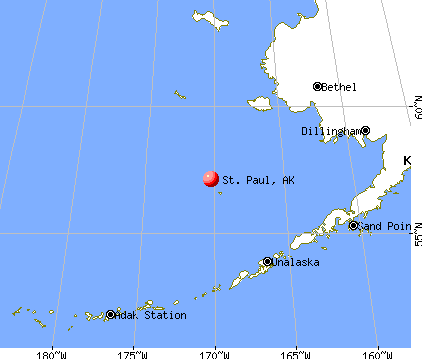
St Paul, Pribilof Islands


(57.08, 170.17)

Once, there was a curious Aleut boy, and early one morning he set out from his village in his sealskin kayak to hunt.  He drifted on calm waters away from his native shore paddling to the west where the seals came through a pass between two islands.  There he waited watching the sea birds alight themselves from the waves to dive on bait fish, when there came a mother pregnant with calve, swimming to the north*.  ‘Why is it,’ he wondered, ‘that all the pregnant mothers swim past our island to the north?’  So he endeavored to follow her to find the answer of where the seals came from.

The further from his shore he paddled the heavier the breeze blew, until a gale had built up blowing winds from the south, the worst of directions for the wind to blow from.  He had no choice but to run with the storm, for he could not make way against it to return home.  For three days he drifted on the wide tossing sea, and everyday the water and the wind were colder than the day before, until on the morning of the fourth day he was becalmed in a dense fog to which he could not see beyond even the bow of his kayak, now burdened with accumulating ice.  Bravely he had held up against his trial at sea, but now, disoriented and cold, he felt at his loneliest and darkest.

Then, from out of the mists he began to hear the baying sounds of seals.  He paddled towards the noise until he heard the sound of breaking surf.  Cautiously he pushed his craft forward peering into the gray nothingness until a surf landed him ashore amid a vast gathering of seals, and as the mist broke and the sun pushed through he could see that the cold barren beaches he had come to were occupied by innumerable seals, so many that he counted them to be as vast as the stars.

Legend has it that he stayed with the seals for a year.  Learning their ways and becoming kin to them before setting out again, now under a northern wind, for his home in the Aleutian Islands.  When he did arrive the people did not know him, but when he unraveled the greatest skin they had ever beheld, and told them of his trials they held for him a great feast, and he recounted his story many times.

* In later times European and American seal hunters would kill the pregnant mothers for the soft skin of the unborn, this was called pelagic hunting.  Pelagic is derived from the Greek Pelagos, meaning sea.  This practice was outlawed, but was very difficult to enforce.


This island, and the lesser three among it was St. Paul of the Pribilof Islands.  250 miles to the north of Dutch Harbor this archipelago stands as lone promontory outpost in the Bering Sea.  These islands look no more than to be frozen plateaus raised from the water.  In the era of discovery they became a prominent sealing station for the Russians, and criminals were sentenced to the island where they were given a quota of seals to kill, skin, then tan.  The hunting was so easy one only had to walk about the shore and club their prey over the head, and the quota could be met in less than half a year.  The life expectancy on these islands was little more than a few years, assuming the convicts arrived at all, for the leaky ships that made the voyage from Kodiak Island were prone to sinking.  With them were also sent Aleut slaves, who were valued for their knowledge in tanning seal hides.  The US came into possession of the Pribilof Islands as a part of the purchase of Alaska, known by the opposition of the purchase as ‘Seward’s Icebox’, in 1867.

Today St Paul has been made infamous by those who have had to travel there, and the conditions they have had to endure.  In comparison with the Aleutians the air here is without humidity.  The dry wind howls unrestrained across the sea at a sustained 30 + knots and is known in gales to gust above 100.  The mercury is prone to stay well below zero, usually 30-40 degrees below.  The harbor here freezes and the seas around it become eerily becalmed with furrowed ridges and small spires of jagged ice. In winters past the Malolo had to break the ice of the harbor in order to land her barge, then break a road through for the fishing fleet to come and process.  One year, I have been oft told, the sea froze as far as sixty miles south holding the little tug in.  She pushed her way slowly through, the wind howling about her at 60 knots, but her steady in the still and swell-less sea.  However, our two visits were mild, and this has been a record warm year for these islands.

The population of the island is mostly Aleut, and there is a cannery owned by Trident Seafood that provides the only economy for the populace.  Without the cannery, this community would probably not exist, and so there are government incentives for it to remain in operation.  Here the harsh realities of the native peoples of these far northern regions are presented with disheartening truth.  Alcohol and depression related illnesses are the leading causes of death here.  Levels of Fetal Alcohol Syndrome are among the highest rates per capita in the US.

From the very limited understanding that I have from my short visit to this part of the world I can speak with no great authority as to these intertwined diseases among natives, if with any authority at all.  Instead, I am confronted with many questions regarding their origin.  Is alcoholism spawned by the depression, or the depression by the alcoholism?  In the case of the former the depression is the primary condition, and the alcohol the copping mechanism.  And so what would be the root of the depression?  The environment?

This could seem likely to one not accustomed to long winters of darkness followed by long summers of daylight, and the winters made longer by the extreme cold, wind, and complete isolation from the world beyond.  But their ancestors, as well as like ancestors of other native northern cultures, such as the Inuit, survived for many millennia before in this environment.  However, it is hard to say how deep the depression was before the arrival of Europeans and Americans.  We do know that other northern cultures of Caucasian ancestry also suffer elevated rates of depression.  Therefore, data could further the argument towards environment being our root cause of depression.

The more interesting question, and one that is pertinent to a present day discussion on a global level, one even relevant to our own society, is one concerning the separations of a people from their life-ways.  Research indicates that the land-bridge has been open multiple times in geological history, and that the first peoples arrived to North America 29,000 years ago.  They were confined to the northern regions by the geography and ice, and so did not migrate down through the planes until 11,500 years ago, or even before that, as new archeology indicates.  Regardless, more reliable archeological evidence indicates that the Aleuts settled into the Aleutian Islands around 12,000 BCE.  Their first encounter with the white settlers advanced technology and domineering / industrious ways was only just over 270 years ago.  And it is worth mentioning that during the times in which most native peoples of America came into first contact with Westerners was at the dawning of the industrial revolution, in which the societies of the arriving new settlers were undergoing their own accelerated growth and change.  The question then is presented; how quickly can a cultural identity bend, or totally conform to a new and dominant culture, especially one so much more economy driven and complex?  What psychological effect does this bear on ones cultural identity, and how intimate is their cultural identity with their personal one?  And this question relates to our own culture, as new technology accelerates at alarming rates, as we are more and more removed from the food chain, and our many micro-cultures become mixed into one global society.  I am not one to answer the question, however it is one worth asking.

Or is it the natives lesser tolerance to Alcohol that sparks alcohol abuse, carrying over to into the disease of alcoholism and sparking depression.  I am told that there are other native communities along the northern extents of the Bering Sea in which Alcohol is banned.  These communities are said to be cleaner, and have better established public services and economies.  In these communities religion is a larger part of their society, and the people are often kinder to visitors, instead of skeptical and bitter towards them.  In short, they are proud peoples.


“There is the bar,” one native said to our second mate, pointing out across the small harbor to the township. “That is where I live,” he said, moving his hand only slightly, indicating a short distance walk to the right.  Then he moved his hand back to a point in-between the bar and home, “That is where I got my DUI,” he said, then said it was cold that night, and he didn’t feel like walking.

And so as a city ordinance the municipality of St. Paul has given up alcohol during the season of lent, and unfortunately, even with a cannery, there is high un-employment, and the majority of the labor force is imported, largely from overseas.

The crew bears great racist resentment towards the natives.  Perhaps this, too, is a piece to the puzzle.  The expectations of the whites here towards the native people are beyond low, to one of disgust and suspicion.  And so after we tied up, and with the sun out and the temperature fresh above freezing, and the half the harbor still iced and good snow on the ground and an hour or two to kill until we began working our barge I told the Captain I was off on a walk about.

This was met with reluctance.  To begin, he is not one who likes his crew leaving his sphere for any length of time unless on official business.  Second, he made it clear to me that I was not to talk to any natives.  That they were dangerous, would drag me into an alley, steal my money, and knife me.

And so, weary of the natives, I disembarked the ship, stopping to take note of the black feral foxes that occupy the island, as well as puffins, and other exotic fowl of arctic origin, then climbed a nearby hill for a good view of the sea, and of the island.


I saw him, hunched and with hands in pocket leaning into his steps, catching a glimpse of a stranger in his eye he veered his course towards where I stood.  His long gray hair blew back atop his shoulders, dark skinned and slant eyed, and no taller that 5 feet, he came alongside me with a genuine grin and he stood quietly looking out across the water.  As I gazed across the blue I was looking on it as one come to see it for the first time, this northern sea foreign to my eyes, but him, he looked out on it with some gaze beyond familiarity, but of oneness, as one looks into a looking glass beyond the features of their face and into their own eyes seeking some connection with their soul unseen, and him seeking from the water a glimpse of something constant to measure the passing of his own time, the sea ever moving yet ever unchanged, and in this same way I look on the old graybearded mountain of home, that ever present foundation and anchor that I recall from my earliest of being, the ever enduring that I can measure my own mortality by.

Then he looks over and says, “Halloo.”  And asks me if I came in on the ship.  I said that I had, and he begins to tell of his days fishing, or of his life when he lived in Seattle, then Anchorage, there was a hint in his narrative of a woman, a love from his past, a romance sadly ended and now him being here living with his sister, working three hours a day at the AC Value Store, but wanting to work more, but there isn’t any work, and he is lucky to have what work he has.  Then he was silent as he grinned, both of us looking out over the water.

“We don’t get a lot of sunny days you know,” he says.  “Got to get out and enjoy them when we get them.”

In the end we shook hands bid each other a good day, and went our separate ways, him to some small shack of a home standing against the ever constant wind, and me to work at breaking the chained lashings from containers, off load, then backload our barge, 18 hour days of hard work against the elements, all for wages, before setting out again for the south, to the islands which once defined this man’s people.

Soon after, in the early morning, as I was having my coffee and planning out the meals of the day, I came across an editorial in a magazine.  In it, the editor Christopher Kimball, quotes a Buddhist aphorism, “Through our suffering, and in the suffering of others, we discover our own humanity”.  I summarize this sentiment in words from the wisest of all southern men, Atticus Finch, with Scout on his knee, saying something to the effect that; you can never know a man until you get into his shoes and walk around a while.  The world is full of them, remote places with remote people hidden from our mainstream eyes, living in isolation, watching through some picture box the ways of the busy world beyond theirs, and looking about their reality, their expectations of themselves brought down low and repeatedly lower, feeling now imprisoned by the same sea or mountains or deserts that once sustained and insulated them.  We may not ever understand this kind of poverty, or any other kind, most will never catch a glimpse of it, though it is everywhere, but we can stubbornly greet strangers with dignity, listen to their story, and imagine wearing their shoes for a while, because they are watching us, and they long to walk about in ours.


Thursday, March 26, 2015

The Aleutian Islands


Unalaska, Dutch Harbor
(53.50’ N, 166.35’ W)

The sun rides its low arch across the southern quarter of the sky, and looking out through the open hatch of the fidley across the back deck are the silhouttes of sea birds, they are the outriders of ships, and they glide without effort like marionettes on the strong breeze that blows off the beam, they dip then rise again over the capping waves of a golden coruscated sea.   And past the trailing barge, basked in the falling light is the Aleutian Island of Unalaska, defined by her serried snow laden peaks that rise aloft amid the incessant storm clouds, and encompassed by the turbulent waters of two converging seas.  This island and her string of sisters were once long ago conceived on a threshold between continental plates where the colliding continents gave rise to the arcing chain of volcanic islands that now define the northern boundary of the great Pacific rim of fire. 

Now look far to the south, by about 2,000 miles.  There lies the center of an extensive chain of seamounts.  And if one traces the line of these mounts one can begin near the historic island atoll of Midway, then follow what looks like an underwater bread crumb trail to the present day big island of Hawaii.  Just to the southeast of this island, below the warm tropic waters is the center of a thin place in the earth’s crust where molten lava bursts through to the cold sea and is ever birthing new land.  In our story of the Aleutian Islands these seemingly insignificant hills far below the surface of the greatest of the world’s oceans become ever more the important key to the creation of this unique landmass reaching out from the Alaskan Peninsula.  For the small island atoll of Midway once occupied the coordinates of the present archipelago of Hawaii, but over millions of years drifted Northwest, confirming to geologists the directional movement of the pacific plate over the Hawaiian hotspot, the same plate that converged, and converges still, just below this ship’s keel. 

It is from these grinding and colliding plates that gave rise the greatest concentration of volcanoes in the world.  Conical peaked mountains pocketed with craters, these islands are dramatic in their elevation.  Some of the more prominent and still active volcanoes rise nearly 10,000 feet above the waves.  But it is the water about them that dominates their stormy features.  To the north of the Aleutian Islands the Bering Sea is shallow, little more than 100 fathoms on average and it is cold, but to the south the Pacific is deep, averaging well over 1,000 fathoms, and it is much warmer, for the Japanese current, much akin to the Atlantic’s Gulf Stream, reaches its apex here before feeding the great Alaskan Gyre, a circulating cauldron of current in this northeastern region of the Pacific.  This warm Japanese current meets the cold waters that flow out of the Arctic through the Bering Straits and the result is that the cold dry air of the north condenses the moist warm air from the Pacific, and when warm meets cold wind is created, and so with a combination of wind and condensation there is persistent storm like conditions that lash the islands with snow and sleet and rain throughout the year maintaining an average temperature just above freezing in the winter, and reaching the 60’s and maybe into the 70’s in the summer. 

To arrive at our bearings geographically, the Aleutians are not as far north as one might think.  Draw a straight line from the southern end of Unalaska to the continent of North America and the ship’s compass arrives us in Queen Charlotte Sound, which is just to the North of Vancouver Island in Canada, making these islands the southern most landmass of the State of Alaska.  Continue East to the Atlantic on this latitude and you will arrive just north of the island of New Foundland, and further again in three weeks sailing time one would arrive in the proximity of Northern Ireland.  In length, these islands are 1,000 miles long, and reach beyond the 180th degree of longitude, placing their farthest outpost in a new day entirely, had not man bent the International Date Line around them to conform to his international boundaries.  

These islands give only enough nutrients for the odd squat pine tree, and are mostly covered in grass, moss, and low shrubs.  The features of the land are difficult to walk across.  The terrain is new born, unsettled by erosion, given to deep swales and precipitous mountains, falling streams over volcanic rock, and the highlands here are in places cloaked in ever grinding glacier fields, that carve away new valleys and great canyons, yet to be revealed to the mortal eye.

Blue foxes call this tussock landscape home, and I recently discovered their shy curiosity as one revealed itself only long enough to flee away just as I was recovering from the unexpected shock of coming across its path.  As large as a small coyote, dark in color, they bound fluidly, much as their cousin the sea otter swims, their spines moving in a wave like motion.  Sea otters are commonly seen floating by on their backs, grasping something in their small hands, a mussel or snail, which they feast upon, and generally take no interest in our happenings.  Also, their larger kin, the seal, slightly more inquisitive, comes by for a look at us as we are passing by on our way to or from some mooring.

But, these islands are mostly inhabited by birds.  No great ornithologist, I can identify few.  The common and most dominant are your usual gulls.  But there are also puffins and cormorants swimming atop and beneath the waves.  They feast the day away and get to be so fat they can’t fly, so as the bow of our ship approaches there is a moment of panic as their wings beat the top of the water, elevating themselves some few inches off the surface, just enough to get out of the way.  But the cormorants take the route of diving, and to watch their acrobatics under the clear water is entertaining. 

The two predatory birds are the ever combating ravens, and their nemeses the scavenging bald eagles.  These eagles are common nuisances here, and occupy every lamppost, road sign, steeple cross, or other elevated perch not yet inhabited by another eagle. They bully the other birds, and are less than their usual iconic regal selves when you come across them diving on dumpsters, their feathers tussled and their white sullied by refuse.  The raven, however, is the Jack of the birds.  Smaller, it relies more on its brain than its brawn.  Known for their intelligence it is said that one ought not kill a raven.  And this is not for fear of some dark superstition derived from their sleek iridescent black coat, but because they mate for life, and should you kill ones partner, the other will not hesitate to follow and torment you for as long as you remain in their territory of influence.  They, too, are connoisseurs of garbage, however they are not so brazen to alight on it in plane sight, but will sneakily steal bit by bit from a bag of trash left out on deck, or in the back of a pickup. 
 
The original inhabitants of these islands were the Aleuts.  A maritime people, they subsisted off of seal and whale meat, and would go offshore in kayaks, and the larger open boats made of whalebone and sealskin known as umiaks.  The Aleuts were known for the curious hats they wore that were made of whale baleen that formed a sort of visor with two feathers hanging down from each side.  A small people, they were peaceful, and took from the sea a good number of skins to keep warm by, and were of a population of about 18,000 when the first contact with whites from Russia came to them in 1741.  This exploration was captained by the Dane, Vitus Bering, who actually unknowingly in the fog passed the island chain on his way east in search of North America.  When Bering arrived at the mainland of America it was in the vicinity of Glacier Bay, and his first sighting was the magnificent volcano, Mt. St. Elias. But his ship was old and of poor construction, so he did not tarry, but turned back only then to discover the Aleutian chain on his return. 


The Russian fur traders would be the next to arrive.  Raping, massacring, and enslaving the native people before converting them, giving them orthodox names, and finally settling into a coexistence with them after having moved them all about this new arm of their western empire.  These first Russians decimated the populations, not only of the people, but of the seals and otters, driving them nearly to extinction with their cruel methods of hunting. 

Captain James Cook also paid a brief visit to the islands to find the Russian influence already rooted.  Then came the whalers from Boston on their search of riches in whale oil, and with them they brought the influence of alcohol, which devastated, and continues to devastated the native populations through out these northern regions. 

The northern shore of Unalaska is defined by two harbors, and this is where man has made his foothold.  Iliuliuk Bay, to the east, is separated from Captain’s Bay by a mountain by the name of Ballyhoo.  This mountain is connected to Unalaska by a small isthmus.  Dutch Harbor rests here under the shadow of Ballyhoo, and across the isthmus rests the older township of Unalaska.  Both harbors are utilized by docking facilities and shipping yards, and occupying any inch of flat land are caches of shipping containers, if not full of crab, then used as storage for the fishing fleets’ gear. 

Ballyhoo and the rest of Dutch Harbor are reminders of how close the war with Japan came to the continental United States.  Japan actually gained a foothold on the islands of Kiska and Attu to the west, the first time since the War of 1812 that American territory has been captured and occupied by enemy forces.  On June 3rd, 1942 two Japanese aircraft carriers launched aircraft for an attack on Unalaska in preparation for a landing there, but were fought off in an aerial dogfight over the island.   Bunkers, pill boxes, aerial towers, military roads, and barracks can still be found here, and as late as the 80’s the roads were still lined with rusting hulks of military vehicles. 


This was a difficult time for the local population.  Soldiers were brought in from all across the United States.  Overnight a movie hall, barrooms, and brothels became establishments of the small township.  There are a number of disappointing accounts of the abuse of the native people, particularly of their women, by U.S. GI’s.  The government soon decided that the two races could not live together on such a small and confined island and so an order was given that the Aleuts inhabiting Unalaska were to be shipped to internment camps, and overnight they were relocated, lining the wharves with little more than cardboard suitcases to carry their possessions as they boarded a rusty hulk of a ship that would carry them to the mainland, and on to an American likeness of a concentration camp.

Today everything that comes to this island, like any island, is imported from the sea.  To build the most modest home would easily cost the builder over 350,000 dollars.  Every nail, timber, and appliance is shipped in.  The cost of groceries also increases, and the cost of a gallon of gas is at 4.50 a gallon.  Given its remote location and cost of living no one moves here, but instead moves away.

Now all this is to describe the place.  You might see it in your mind’s eye filling in the voids with your imagination, and in this way you may suffice your need to know more.  Or, to accompany words you may look upon some server to gather a more concise image of where and what these pages have attempted through wordsmithing to convey.  But the image still lacks dimension.  In the ever-nomadic course which a sailor’s life steers one makes port in regions far and near.  The brief interlude in port affords little time, but if one is adept one can soon feel the very soul of a place.  And it is this soul that gives us the most honest definition.

But what defines the soul of a place?  The people?  What defines the people?  The environment in which they live?  Their history?   But here is the rub.  A port such as Unalaska and Dutch Harbor where the vast number of its inhabitants are migrant takes for itself a transient soul.  Riding the streets this town is a shell of its former self.  Once a strong Aleut community, few have remained, but the industries and wealth here are for the outsiders.  Most occupants bear no roots to this place, and ill-associate it with their servitude to vessels and canneries, made even drearier by the weather, in which the forecast is always, “transitioning from shit to shittier, and progressively getting worse by the hour.”  These temporary inhabitants are always sadly coming as paupers, and happily going with pockets well laden in wages.  They have created an atmosphere that is reticent of the last of the fabled pirate towns, or even perhaps of town’s like Dawson City, where the dream of fortunes meet reality and wash themselves out in drink.  And so the sailor bars and women of trade here are infamous, and the stories of drunken brawls and broken glass seem to abound. 


But for those of us not consumed in the bottle, we are working.  We are transiting between hardware stores, grocers, and shipyards by truck or by boat, clad in a uniform of Grunden foul weather jackets, Carhart pants, and Xtra Tuff sea boots.  We are all comrades in purpose and we are all biding our time.  We are far from home, family, and often kindness.  We are hardened by this place, and are men without women who toil against the elements, but when one stops for a moment and looks out anew through virgin eyes, having quieted the over industrious mind, then perhaps one might see Captain’s Bay in a mirror like calm, the mist rising off the still water, and the umber base of the mountains rising up and rimmed afresh with rime ice below the peaked lofts of snow, and the colors of the sun rising over Pyramid Peak varying its cast of hues through the clouds from glacier blue to stormy gray, and ignited with flakes of gold, and as you sip your coffee an otter swims on its back past your hull, its nose working the smells of a clam chowder as it stews in the galley, then all the hardness is cleansed away for the moment, and you can remember that before man was here, there was creation, and in the dichotomies of nature there was a balance, and as all things can be born down into the one universal truth that reveals itself in infinite subtle shades, that this time here is temporary for everyone, a moment in a fluid continuum, and it is not to be shied away from or simply endured, but that instead much is to be gained, and these islands are monuments to this concept, that they stand between two seas and two plates, born up by conflict and ever taken slowly away by it, and that this harsh home is mother to a great diversity of life, that in this ruggedness is a beauty few will ever see, but that all could